

The question that changes everything.
When the hard things keep coming, there's one shift that changes how you meet them. It starts with meaning.

This is Letter 4 in our five part series on stress, anxiety, and what to actually do about the state of the world right now. We’ve covered the neuroscience of stress, what it physically does to the body, and the research on human resilience. Today we go somewhere that I find personally, deeply, uncomfortably true.
I want to talk about meaning.
And before you roll your eyes, I promise this is not a spiritual bypass. This is not “everything happens for a reason” dressed up in nicer clothes. What I want to share is something much more grounded than that, and much more demanding.
Something I’ve noticed aross years of teaching and coaching and now therapy training, I keep seeing the same pattern.
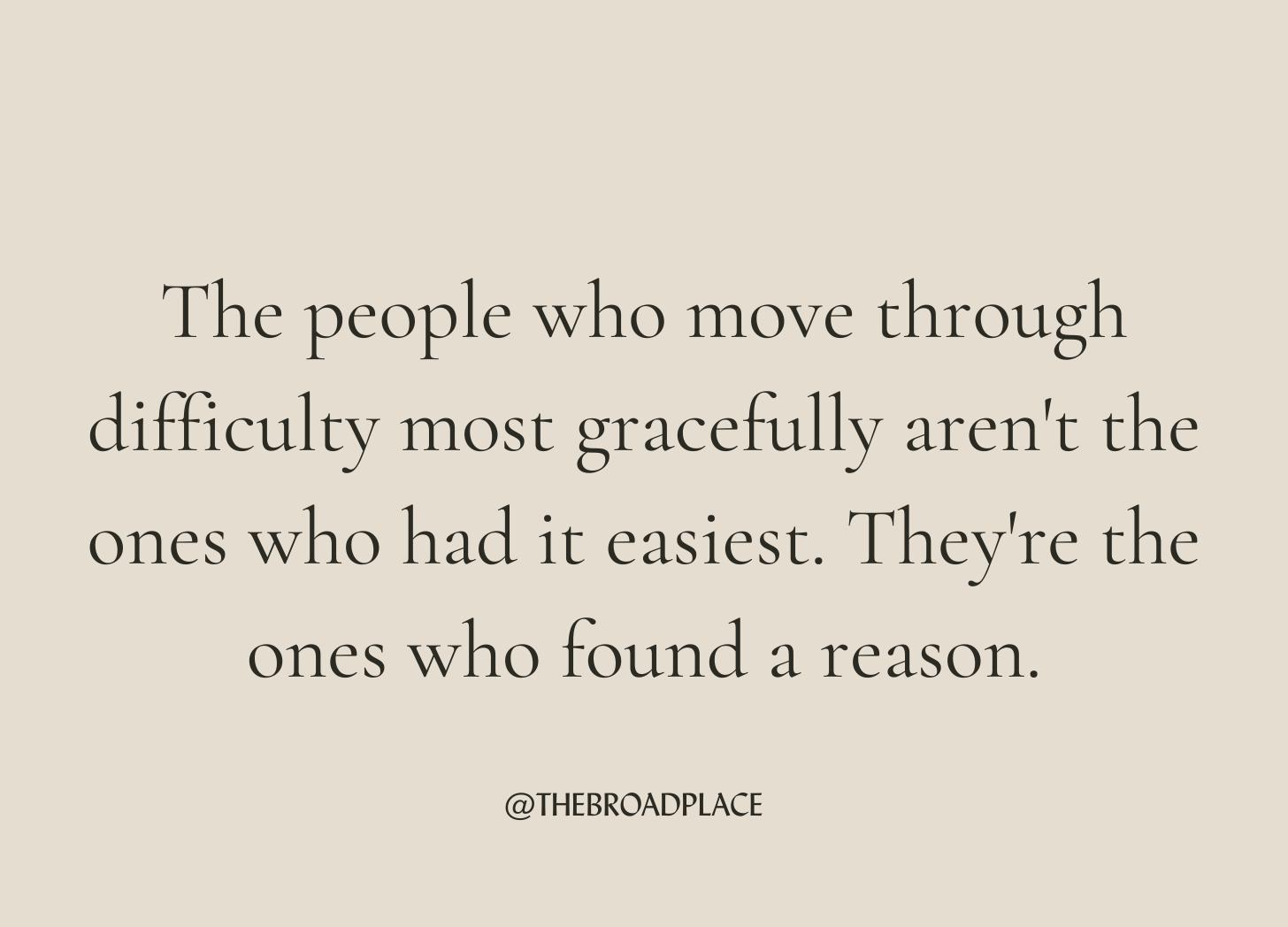
The people who move through difficulty most gracefully are rarely the ones who had the easiest circumstances. They’re the ones who found a reason. Not a silver lining. Not a forced reframe. A genuine sense that what they were going through was pointing them somewhere, teaching them something, making them into someone more capable of contributing to the world around them. This is not a passive thing. It is an active choice made under pressure. And it is one of the most powerful things I have ever witnessed in another human being.
Let’s chat Malala.
In 2012 Malala Yousafzai was fifteen years old when she was shot in the head on her school bus in Pakistan. She had been targeted for speaking out about girls’ right to education. The attack was intended to silence her. It did the opposite.
During her recovery Malala made a decision that most of us will never be asked to make, and yet one that contains a lesson available to all of us. She chose to understand what had happened to her not as the end of something but as the beginning. Not as a wound that defined her but as a clarification of what she was here to do. She didn’t minimise what had happened. She didn’t perform resilience for an audience. She sat with the difficulty honestly and she asked: what does this make possible? The answer became a Nobel Peace Prize. A global education fund. A voice that has reached millions of people who needed to hear it.
What I mean by meaning.
Finding meaning in difficulty is not the same as being grateful for it. I want to be really clear about that because I think it’s where people get lost. It is not pretending it isn’t hard. It is asking, honestly and quietly and without forcing an answer, what this experience might be making possible. What it might be opening. What you might be learning about yourself that you couldn’t have learned any other way.
I think about my own life here constantly. The bankruptcy that felt like total annihilation turned out to be the thing that freed me from a version of success I hadn’t consciously chosen. The pandemic that stripped everything back revealed what actually mattered. The losses that broke my heart open made me a better teacher, a more honest person, a more genuinely useful presence in other people’s lives.
None of that made the hard things less hard in the moment. But meaning made them navigable. And navigable, over time, became transformative. I genuinely believe this is one of the great undiscussed opportunities of this particular moment in history. Things are hard right now. Genuinely hard for many people. And inside that hardship is an invitation that most people will miss because they’re too busy scrolling away from the discomfort to sit inside it long enough to hear it.
The research
Studies on post-traumatic growth consistently find that people who locate meaning in their adversity don’t just recover. They often report greater clarity, deeper relationships, expanded capacity, and a stronger sense of purpose than before the difficulty occurred. Not always. Not automatically. But far more often than the culture of catastrophe would have us believe.
This is available to you. Right now. In whatever is hard right now.
What is your hard thing right now? And what, even slightly, might it be making possible? I would genuinely love to know. And see you tomorrow for the final letter in this series. We bring it all together. And I’ll share the four things the research says you can actually do, starting today, to meet this moment well.
With love,
Jac
If you’re in a season of difficulty right now and you want somewhere to go with all of it, somewhere that offers real tools, real community, and guidance at your own pace, I want to tell you about The Portal.
Our global membership. Full course library. Monthly live calls with me. A community of people around the world doing the quiet serious work of living with more consciousness and less fear.
Come and ask the deeper questions with us.
Join The Portal → The Portal
The Meaning Audit Logotherapy
Give yourself 15 uninterrupted minutes. Do it in writing. Writing externalises the thought process in a way that thinking alone doesn’t.
For paid subscribers: your practical tool for today is below.
